 Add to Chrome
 Add to Firefox
 Add to Edge
SHARP: Sleep-based Hierarchical Accelerated Replay for Long Range Non-Stationary Temporal Pattern Recognition
May 30, 2026
Learning long-range non-stationary temporal patterns remains a core challenge for modern sequence models, particularly in strict streaming settings. In these settings, data arrive sequentially and must be processed in a single pass without simultaneously revisiting past observations. Standard architectures, including recurrent neural networks and transformers, are constrained by either truncated backpropagation through time horizon or explicit input window length for long range credit assignment. To address these limitations, we propose SHARP (Sleep-based Hierarchical Accelerated Replay), a framework that decomposes temporal learning into two complementary components: a memory module that accumulates a structured history of past inputs, and a pattern-recognition module that operates over this memory. This separation enables resource- and compute-efficient adaptation to non-stationary dynamics by eliminating the need for backpropagation through time across many steps for long-range credit assignment. Inspired by the accelerated replay observed in rodents during slow-wave sleep, SHARP incorporates offline (sleep) phases in which temporally structured memory traces are replayed in an accelerated form and integrated into higher-level memory representations, improving long-range context retention. Through controlled simulations and ablation studies, we characterize the key properties of the proposed framework. In benchmark datasets such as text8 and PG-19, we demonstrate that SHARP improves over recurrent baselines by retaining next-token predictive performance on previously seen data while continuing to learn from the current stream and generalizing to future unseen data. These gains are enabled by its hierarchical structure, which yields an exponentially increasing effective temporal context with only linear-time computational cost.

BayMOTH: Bayesian optiMizatiOn with meTa-lookahead -- a simple approacH
Apr 13, 2026Bayesian optimization (BO) has for sequential optimization of expensive black-box functions demonstrated practicality and effectiveness in many real-world settings. Meta-Bayesian optimization (meta-BO) focuses on improving the sample efficiency of BO by making use of information from related tasks. Although meta-BO is sample-efficient when task structure transfers, poor alignment between meta-training and test tasks can cause suboptimal queries to be suggested during online optimization. To this end, we propose a simple meta-BO algorithm that utilizes related-task information when determined useful, falling back to lookahead otherwise, within a unified framework. We demonstrate competitiveness of our method with existing approaches on function optimization tasks, while retaining strong performance in low task-relatedness regimes where test tasks share limited structure with the meta-training set.
Modular Memory is the Key to Continual Learning Agents
Mar 02, 2026Foundation models have transformed machine learning through large-scale pretraining and increased test-time compute. Despite surpassing human performance in several domains, these models remain fundamentally limited in continuous operation, experience accumulation, and personalization, capabilities that are central to adaptive intelligence. While continual learning research has long targeted these goals, its historical focus on in-weight learning (IWL), i.e., updating a single model's parameters to absorb new knowledge, has rendered catastrophic forgetting a persistent challenge. Our position is that combining the strengths of In-Weight Learning (IWL) and the newly emerged capabilities of In-Context Learning (ICL) through the design of modular memory is the missing piece for continual adaptation at scale. We outline a conceptual framework for modular memory-centric architectures that leverage ICL for rapid adaptation and knowledge accumulation, and IWL for stable updates to model capabilities, charting a practical roadmap toward continually learning agents.
Benchmarking Video Foundation Models for Remote Parkinson's Disease Screening
Feb 13, 2026Remote, video-based assessments offer a scalable pathway for Parkinson's disease (PD) screening. While traditional approaches rely on handcrafted features mimicking clinical scales, recent advances in video foundation models (VFMs) enable representation learning without task-specific customization. However, the comparative effectiveness of different VFM architectures across diverse clinical tasks remains poorly understood. We present a large-scale systematic study using a novel video dataset from 1,888 participants (727 with PD), comprising 32,847 videos across 16 standardized clinical tasks. We evaluate seven state-of-the-art VFMs -- including VideoPrism, V-JEPA, ViViT, and VideoMAE -- to determine their robustness in clinical screening. By evaluating frozen embeddings with a linear classification head, we demonstrate that task saliency is highly model-dependent: VideoPrism excels in capturing visual speech kinematics (no audio) and facial expressivity, while V-JEPA proves superior for upper-limb motor tasks. Notably, TimeSformer remains highly competitive for rhythmic tasks like finger tapping. Our experiments yield AUCs of 76.4-85.3% and accuracies of 71.5-80.6%. While high specificity (up to 90.3%) suggests strong potential for ruling out healthy individuals, the lower sensitivity (43.2-57.3%) highlights the need for task-aware calibration and integration of multiple tasks and modalities. Overall, this work establishes a rigorous baseline for VFM-based PD screening and provides a roadmap for selecting suitable tasks and architectures in remote neurological monitoring. Code and anonymized structured data are publicly available: https://anonymous.4open.science/r/parkinson\_video\_benchmarking-A2C5
Dynamic Sparse Training of Diagonally Sparse Networks
Jun 13, 2025Recent advances in Dynamic Sparse Training (DST) have pushed the frontier of sparse neural network training in structured and unstructured contexts, matching dense-model performance while drastically reducing parameter counts to facilitate model scaling. However, unstructured sparsity often fails to translate into practical speedups on modern hardware. To address this shortcoming, we propose DynaDiag, a novel structured sparse-to-sparse DST method that performs at par with unstructured sparsity. DynaDiag enforces a diagonal sparsity pattern throughout training and preserves sparse computation in forward and backward passes. We further leverage the diagonal structure to accelerate computation via a custom CUDA kernel, rendering the method hardware-friendly. Empirical evaluations on diverse neural architectures demonstrate that our method maintains accuracy on par with unstructured counterparts while benefiting from tangible computational gains. Notably, with 90% sparse linear layers in ViTs, we observe up to a 3.13x speedup in online inference without sacrificing model performance and a 1.59x speedup in training on a GPU compared to equivalent unstructured layers. Our source code is available at https://github.com/horizon-research/DynaDiag/.
A Good Start Matters: Enhancing Continual Learning with Data-Driven Weight Initialization
Mar 09, 2025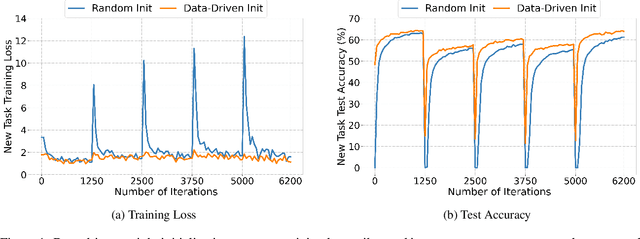
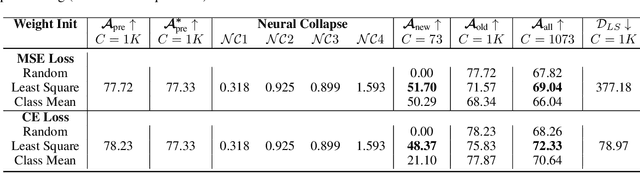
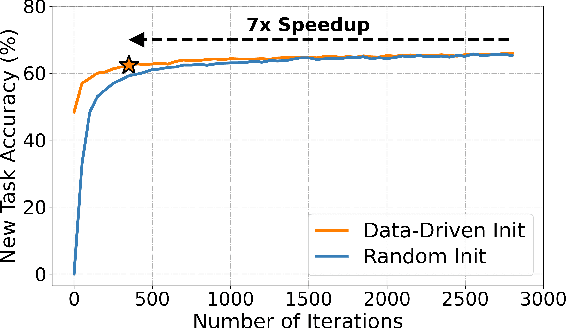
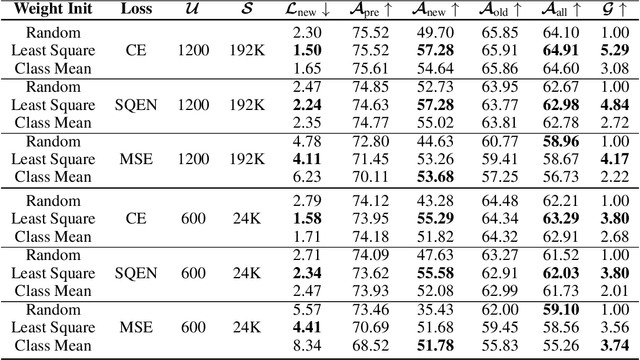
To adapt to real-world data streams, continual learning (CL) systems must rapidly learn new concepts while preserving and utilizing prior knowledge. When it comes to adding new information to continually-trained deep neural networks (DNNs), classifier weights for newly encountered categories are typically initialized randomly, leading to high initial training loss (spikes) and instability. Consequently, achieving optimal convergence and accuracy requires prolonged training, increasing computational costs. Inspired by Neural Collapse (NC), we propose a weight initialization strategy to improve learning efficiency in CL. In DNNs trained with mean-squared-error, NC gives rise to a Least-Square (LS) classifier in the last layer, whose weights can be analytically derived from learned features. We leverage this LS formulation to initialize classifier weights in a data-driven manner, aligning them with the feature distribution rather than using random initialization. Our method mitigates initial loss spikes and accelerates adaptation to new tasks. We evaluate our approach in large-scale CL settings, demonstrating faster adaptation and improved CL performance.
INSIGHT: Explainable Weakly-Supervised Medical Image Analysis
Dec 02, 2024

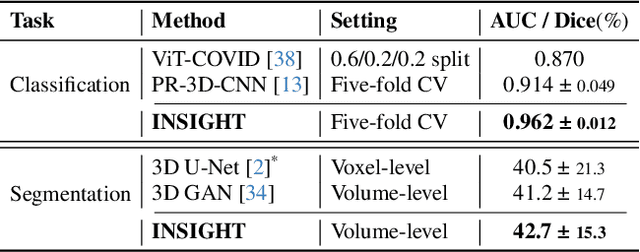

Due to their large sizes, volumetric scans and whole-slide pathology images (WSIs) are often processed by extracting embeddings from local regions and then an aggregator makes predictions from this set. However, current methods require post-hoc visualization techniques (e.g., Grad-CAM) and often fail to localize small yet clinically crucial details. To address these limitations, we introduce INSIGHT, a novel weakly-supervised aggregator that integrates heatmap generation as an inductive bias. Starting from pre-trained feature maps, INSIGHT employs a detection module with small convolutional kernels to capture fine details and a context module with a broader receptive field to suppress local false positives. The resulting internal heatmap highlights diagnostically relevant regions. On CT and WSI benchmarks, INSIGHT achieves state-of-the-art classification results and high weakly-labeled semantic segmentation performance. Project website and code are available at: https://zhangdylan83.github.io/ewsmia/
Improving Multimodal Large Language Models Using Continual Learning
Oct 25, 2024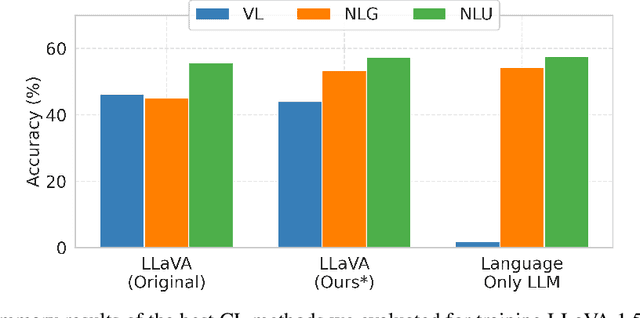
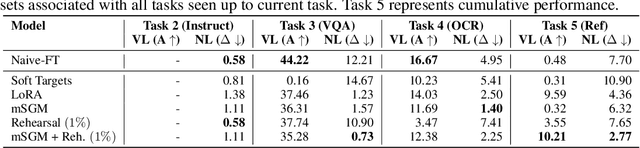
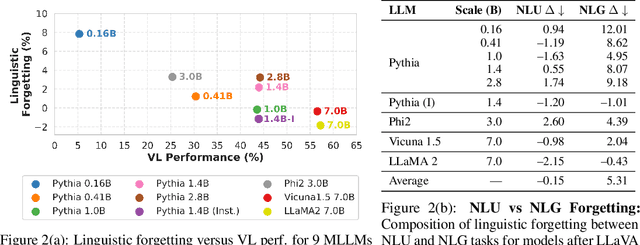
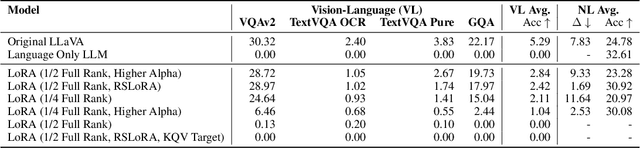
Generative large language models (LLMs) exhibit impressive capabilities, which can be further augmented by integrating a pre-trained vision model into the original LLM to create a multimodal LLM (MLLM). However, this integration often significantly decreases performance on natural language understanding and generation tasks, compared to the original LLM. This study investigates this issue using the LLaVA MLLM, treating the integration as a continual learning problem. We evaluate five continual learning methods to mitigate forgetting and identify a technique that enhances visual understanding while minimizing linguistic performance loss. Our approach reduces linguistic performance degradation by up to 15\% over the LLaVA recipe, while maintaining high multimodal accuracy. We also demonstrate the robustness of our method through continual learning on a sequence of vision-language tasks, effectively preserving linguistic skills while acquiring new multimodal capabilities.
Can Kans (re)discover predictive models for Direct-Drive Laser Fusion?
Sep 13, 2024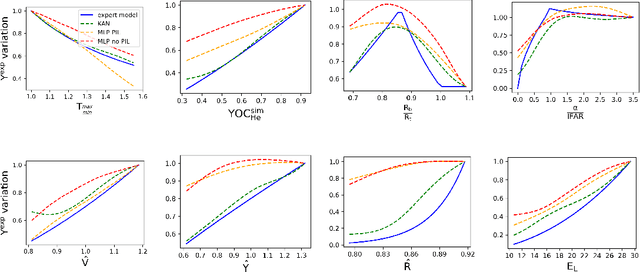
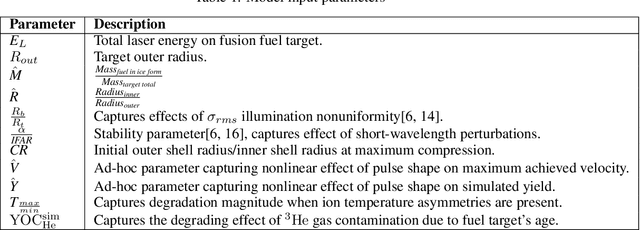
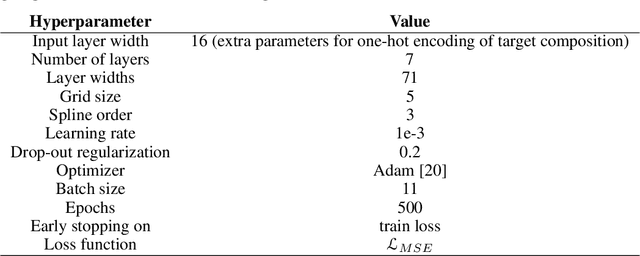
The domain of laser fusion presents a unique and challenging predictive modeling application landscape for machine learning methods due to high problem complexity and limited training data. Data-driven approaches utilizing prescribed functional forms, inductive biases and physics-informed learning (PIL) schemes have been successful in the past for achieving desired generalization ability and model interpretation that aligns with physics expectations. In complex multi-physics application domains, however, it is not always obvious how architectural biases or discriminative penalties can be formulated. In this work, focusing on nuclear fusion energy using high powered lasers, we present the use of Kolmogorov-Arnold Networks (KANs) as an alternative to PIL for developing a new type of data-driven predictive model which is able to achieve high prediction accuracy and physics interpretability. A KAN based model, a MLP with PIL, and a baseline MLP model are compared in generalization ability and interpretation with a domain expert-derived symbolic regression model. Through empirical studies in this high physics complexity domain, we show that KANs can potentially provide benefits when developing predictive models for data-starved physics applications.
Revisiting Multi-Modal LLM Evaluation
Aug 09, 2024
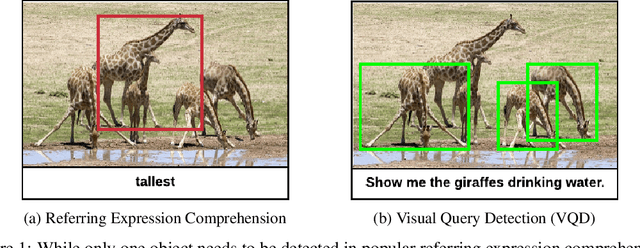

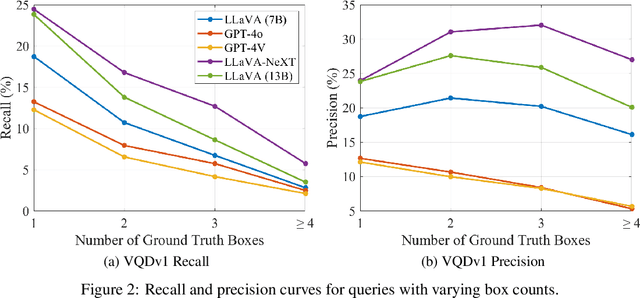
With the advent of multi-modal large language models (MLLMs), datasets used for visual question answering (VQA) and referring expression comprehension have seen a resurgence. However, the most popular datasets used to evaluate MLLMs are some of the earliest ones created, and they have many known problems, including extreme bias, spurious correlations, and an inability to permit fine-grained analysis. In this paper, we pioneer evaluating recent MLLMs (LLaVA 1.5, LLaVA-NeXT, BLIP2, InstructBLIP, GPT-4V, and GPT-4o) on datasets designed to address weaknesses in earlier ones. We assess three VQA datasets: 1) TDIUC, which permits fine-grained analysis on 12 question types; 2) TallyQA, which has simple and complex counting questions; and 3) DVQA, which requires optical character recognition for chart understanding. We also study VQDv1, a dataset that requires identifying all image regions that satisfy a given query. Our experiments reveal the weaknesses of many MLLMs that have not previously been reported. Our code is integrated into the widely used LAVIS framework for MLLM evaluation, enabling the rapid assessment of future MLLMs. Project webpage: https://kevinlujian.github.io/MLLM_Evaluations/